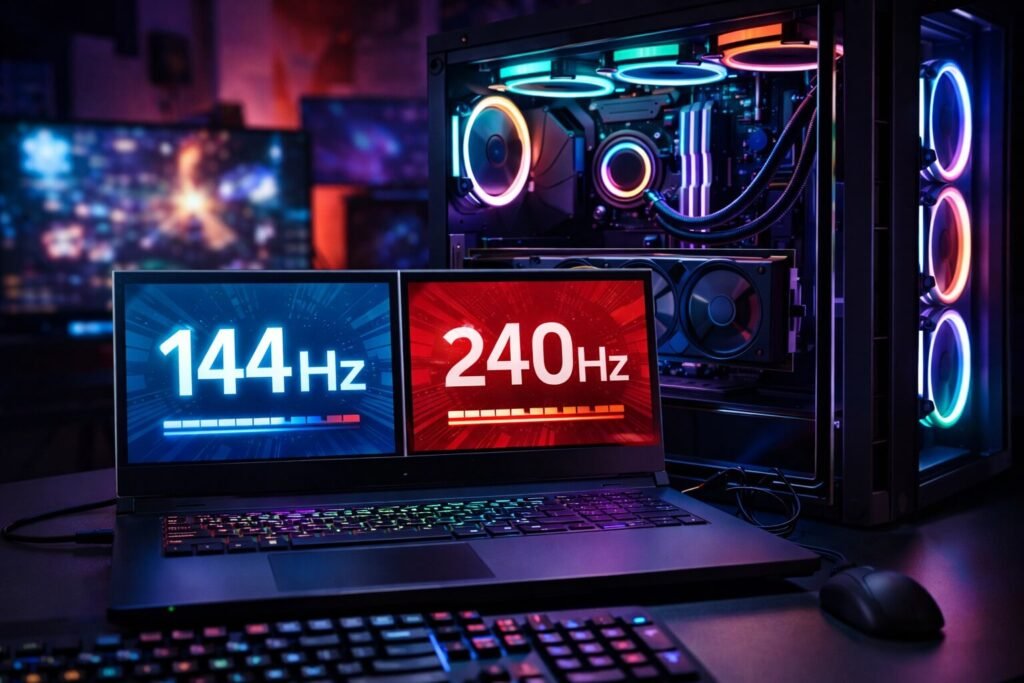
Buying a high refresh rate monitor is the easy part.
The “why does it still feel like 60Hz?” part usually comes down to one of these:
- Windows is still set to 60Hz
- you’re not using the right port/cable settings
- Variable Refresh Rate (G-SYNC / FreeSync) isn’t enabled
- your FPS is bouncing all over the place (which feels worse than a lower but stable frame rate)
Let’s fix this properly — in the order that actually makes a difference.
Quick checklist (biggest wins first)
- Set your monitor to the correct refresh rate in Windows (most common miss).
- Enable G-SYNC (NVIDIA) or FreeSync (AMD) if your monitor supports VRR.
- Use a sane FPS cap strategy so you don’t slam into the refresh ceiling (reduces tearing + input lag spikes with VRR).
- Fix “fake stutter”: background overlays, unstable frame times, and wrong game display mode.
1) First: make sure Windows is actually running at 144Hz/240Hz
This is the #1 reason high refresh monitors don’t feel high refresh.
Microsoft’s official steps are:
- Settings → System → Display
- Select your display (if you have multiple)
- Open Advanced display
- Choose your rate under Choose a refresh rate
Important: Microsoft notes the list only shows what your display supports (and some refresh rates may not support your current resolution).
If you do nothing else in this guide, do this.
2) Enable VRR (G-SYNC / FreeSync) for smoother motion and less tearing
High refresh feels best when your FPS and refresh rate are working together.
If you’re on NVIDIA: enable G-SYNC / G-SYNC Compatible
NVIDIA’s Control Panel Help spells out the path:
- NVIDIA Control Panel → Display → Set up G-SYNC → check Enable G-SYNC / G-SYNC Compatible and choose fullscreen or windowed+fullscreen mode.
What this does: it helps smooth out frame delivery so you get less tearing and less “micro-judder” when FPS fluctuates.
If you’re on AMD: enable FreeSync
AMD provides a straightforward guide for enabling/checking FreeSync in AMD Software: Adrenalin Edition via Display settings.
Quick expectation setting: VRR helps most when your frame rate is near your refresh rate but not perfectly locked.
3) The “high refresh secret”: stable frame times beat higher FPS
A 240Hz monitor doesn’t magically make unstable frame times feel good.
What you’re optimizing for is:
- consistent frame pacing
- low latency (especially for competitive shooters)
- FPS staying within your monitor’s VRR range (if you’re using VRR)
That’s why the next section matters.
4) Use the right FPS cap strategy (especially with VRR)
If you use VRR (G-SYNC/FreeSync), you generally want to avoid constantly hitting the refresh rate ceiling. When you slam into the ceiling, behavior changes (VRR can disengage or you can get latency/tearing quirks depending on settings).
Blur Busters’ long-running G-SYNC tuning guidance discusses keeping performance behavior consistent and how certain combinations (VRR + V-Sync + latency tools) create an automatic framerate limit under the refresh rate.
Practical, easy rules (that work for most people)
- Competitive games (lowest latency focus):
- Use in-game FPS cap (or driver cap if needed)
- Lower graphics until FPS is stable
- Use in-game FPS cap (or driver cap if needed)
- Single player / smoothness focus:
- VRR ON
- Keep FPS stable (cap if needed)
- Don’t chase max settings if it makes frame time spiky
- VRR ON
Note: There are multiple “correct” setups here depending on whether you prioritize latency or smoothness — the point is to pick one strategy and keep it consistent.
5) Make sure you’re using the right display path (port / mode / monitor settings)
This is where a lot of “I can’t select 240Hz” issues come from:
- wrong port (some monitors only support max Hz on specific ports)
- wrong cable standard
- monitor OSD setting not enabled (some monitors need “Overclock” / “High refresh” toggled)
- resolution too high for the selected refresh rate
Microsoft also notes the available refresh rates depend on the display and what it supports.
If 144/240Hz isn’t showing up in Windows:
- try a different port on the monitor
- check the monitor’s OSD settings
- lower resolution temporarily to confirm the monitor exposes higher Hz
6) Game settings that actually matter for high refresh
This is the “don’t overcomplicate it” section.
A) Use the best display mode for your game
- Many competitive players prefer exclusive fullscreen for consistency.
- Borderless can be fine, but can sometimes add overhead depending on the game and Windows behavior.
B) Lower the settings that hurt frame time stability first
If your FPS is bouncing, lower the usual culprits:
- shadows
- volumetrics
- ray tracing
- view distance
- heavy post-processing
High refresh feels amazing when frame time is stable — even if visuals aren’t maxed.
C) Watch out for overlays and capture tools
FPS counters, recording overlays, browser video playing on a second screen — these can all add jitter or spikes.
7) Quick troubleshooting (common high-refresh problems)
“My monitor is 144Hz but it feels like 60Hz”
- Confirm Windows refresh rate is set correctly in Advanced display.
“I enabled VRR but I still get tearing”
- Make sure VRR is enabled in the correct driver panel (NVIDIA G-SYNC / AMD FreeSync).
- Ensure your FPS isn’t constantly slamming into the refresh ceiling (cap strategy section).
“240Hz isn’t available as an option”
- It’s usually a port/cable/monitor-setting limitation (see section 5).
- Also confirm you’re not using a resolution that blocks that Hz tier.
Related Articles:
- How to Optimize a Gaming Laptop for VR (Smooth PCVR Without Stutter)
- How to Fix Input Lag on a Gaming TV
- How to Optimize Xbox Series X for Low Latency Gaming
Get in Touch!
Small tweaks make a big difference. Want more practical tech guides like this?
Sign up for the Techgiant.net newsletter and get daily tips, app guides, and no-nonsense tech and gaming updates, straight to your inbox.
FAQs
How do I make sure my PC is actually running at 144Hz or 240Hz?
Go to Windows Advanced display and choose the correct refresh rate.
Should I enable G-SYNC or FreeSync?
If your monitor supports it, yes — enable it in your GPU control panel/software for smoother gameplay when FPS fluctuates.
What’s more important: higher FPS or stable frame time?
Stable frame time. High refresh feels best when FPS delivery is consistent.
Why does my game feel stuttery even at high FPS?
Frame pacing issues (spikes), overlays, unstable settings, or mismatched VRR/FPS behavior are the usual causes.
References
https://support.microsoft.com/en-us/windows/change-the-refresh-rate-on-your-monitor-in-windows-c8ea729e-0678-015c-c415-f806f04aae5a
https://www.nvidia.com/content/Control-Panel-Help/vLatest/en-us/mergedProjects/nvdsp/To_use_variable_refresh_rates.htm
https://www.amd.com/en/resources/support-articles/faqs/DH3-013.html
https://blurbusters.com/gsync/gsync101-input-lag-tests-and-settings/